


Outline
SimMonitor accurately reproduces dynamic physiological monitoring data across diverse clinical scenarios for different age groups and clinical presentations, incorporating audible and visual alarms to create immersive emergency training environment. It enables case editing and integrates with fundamental first-aid training model, allowing for more complex clinical rescue scenarios.
Gained Skilled
· Operation of ECG monitoring equipment
· Dynamic interpretation of ECG monitoring data
· Analysis and assessment of patient condition
· Critical alarm response
· Clinical decision-making
Features
Patient Monitor Simulator
1. Realistic Appearance & Comprehensive Ports
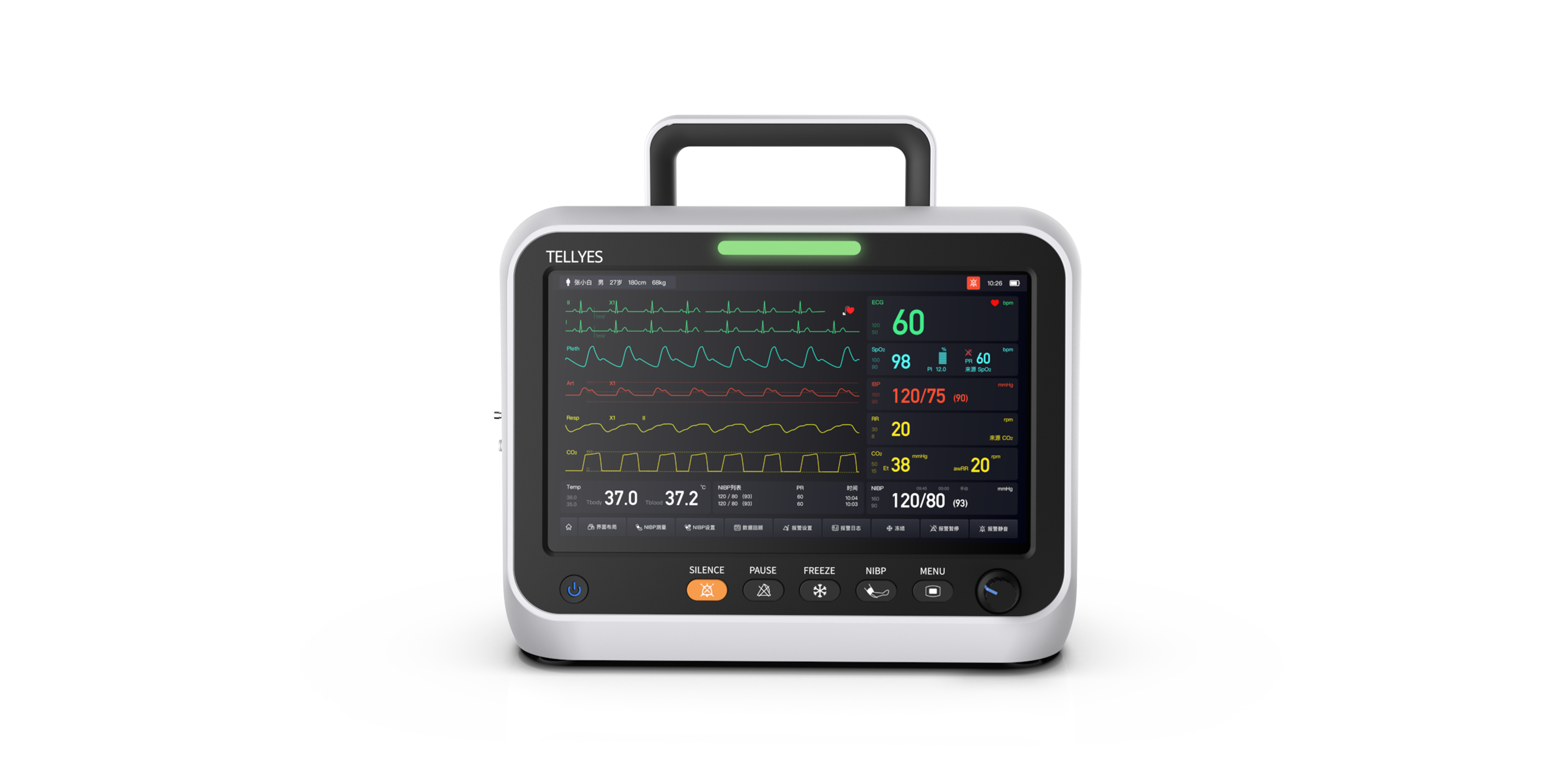
1) Design: Features a high-fidelity replica of a real bedside patient monitor, complete with a touchscreen for clear display of vital sign waveforms and parameters, ensuring intuitive and convenient operation.
2) Standard Ports: Equipped with 5 standard functional ports on the side, identical to real monitors in their connection methods. Compatible accessories include:
--A realistic 5-lead ECG cable with lead-off detection, triggering an "ECG Lead Off" prompt.
--A simulated pulse oximetry probe capable of quickly detecting finger clip detachment.
--A simulated temperature probe.
--A CO₂ sampling line.
--A simulated NIBP cuff that realistically inflates and deflates during measurement.
2. Physical Keys & Core Functions
1) Alarm Silence Key: Instantly silences all active alarms with one press, press again to resume.
2) Alarm Pause Key: Pauses all alarm sounds for 2 minutes, after which alarms automatically reactivate.
3) Alarm System: Triggers audible & visual alerts (including parameter background flashing) when values exceed set thresholds. A distinct alarm sound activates for ECG asystole.
4) Freeze Key: Instantly freezes the current waveform on screen for detailed trainee observation and analysis.
5) NIBP Key: Initiates a single simulated non-invasive blood pressure measurement with automatic cuff inflation/deflation and real-time value update.
6) Menu Key: Provides quick access to various lab and examination results sent from the instructor station.
7) Navigation Knob: Features a smooth, endless rotation design (clockwise/counter-clockwise) for selecting on-screen functions. Pressing the knob confirms and executes the selected action.
3. Screen Functions & System Configuration
1) Patient Info: Centrally displays case information (Name, Sex, Age, Height, Weight), device connection status, time, and battery level.
2) Layout Settings: Supports switching between multiple monitoring layouts, including 3-waveform, 4-waveform, 5-waveform, neonatal interface, large-font mode, and 7-lead ECG display.
--Parameters and waveform types can be customized in the 3, 4, and 5-waveform layouts.
--Parameter Options: SpO₂, CO₂, RR, IBP, CVP, PAP, ICP, PAWP, C.O., Temp, NIBP, NIBP list, BIS, HR, PR.
--Waveform Options: ECG leads, Pleth (PPG), Resp (Respiration), ABP/IBP (Invasive Blood Pressure).
3) NIBP Settings: Offers manual or automatic NIBP measurement modes. The auto mode provides 12 selectable intervals ranging from 10 seconds to 3 hours.
4) Data Review:
--Provides trend review for parameters including HR, PR, SpO₂, ETCO₂, RR, NIBP, IBP, Tbody, C.O., CVP, PAP, PAWP, ICP, and BIS. Selectable time windows: 1, 5, 15, 30, 60 minutes.
--Automatically logs details of each NIBP measurement: time, value, and type (Auto/Manual).
5) Alarm Management:
--Allows personalized alarm configuration (status, limits, volume) for parameters: HR, SpO₂, ETCO₂, RR, NIBP, IBP, Temp, C.O., CVP, PAP, ICP, NIBP-Arm, NIBP-Leg.
--Alarms are triggered when monitored data exceeds the set limits.
--All alarm events are automatically recorded in an alarm log (including time, parameter, cause) for easy debriefing and review.
4. Extensions & Connectivity
1) Display Extension: Supports HDMI output to mirror the screen content to a larger display.
2) Data Output: Can connect to a printer for direct printing of ECG waveform strips.
3) Quick Connection: Offers three convenient methods to connect the smart control station to the simulator:
--Connection via Wi-Fi network.
--Connection via the hotspot created by the simulated patient monitor.
--Direct connection by scanning the QR code displayed on the simulated patient monitor screen.
Lite Control Software
1. The instructor station offers a choice between three modes: Patient Mode, Case Mode, and Standalone Mode.
·Patient Mode: Includes default patient profiles with age, height, weight, and profile photo for the following categories: elderly/middle-aged/young male and female, male and female child, infant, newborn, and preterm infant.
·Case Mode: Includes 15 cases, each displaying the case name, patient information (name, age, gender, height, weight, profile photo), case description, and initial vital signs.
·Standalone Mode: Enables quick setting of parameter values including HR, RR, SpO2, NIBP, IBP, Temp, Tblood, ICP, PAP, CVP, C.O., PAWP, BIS, NIBP-Arm, NIBP-Leg, with an eye icon to show/hide each parameter on the patient monitor. It also supports trend variation settings, including transition duration and curve.
---The “Prepare ECG” button allows for the quick application of 16 preset ECG waveforms, and this function is available in all three modes.
---The “Vital Signs Queue” button enables rapid configuration of vital sign trends, including transition duration and curve settings. This feature is accessible in both Patient Mode and Case Mode.
Functions Available in Patient Mode and Case Mode
1) Dynamic Condition Simulation
During a running case, instructor can activate different physiological states to simulate changes in the patient's condition. Complications can also be quickly added to achieve immediate adjustments to the patient's status.
2) Teaching Evaluation System
Instructor can record and evaluate learner actions within the "Intervention" module. Learner or team names can be added in the personnel management section for targeted recording and assessment, allowing for evaluation based on specific actions under different intervention methods.
Instructors can also quickly log and evaluate learner performance using icon-based notation.
3) Quick Assessment of Key Procedures
The system provides defibrillation, pacing, and CPR quick-assessment buttons to help instructor evaluate critical actions in real time:
--Defibrillation: Supports evaluation of defibrillation mode and energy.
--Pacing: Supports evaluation of pacing rate and current.
--CPR: Supports evaluation of patient response check, compression depth, compression position, chest recoil, compression frequency, compression interruption, airway opening, tidal volume, and ventilation duration.
4) Medical File Import to Monitor
Instructor can send preset medical files (such as lab reports and examination results) to the patient monitor interface, enabling learners to view relevant patient test information in real time.
5) Auscultation and Voice Simulation
The system includes built-in common heart sounds, breath sounds, bowel sounds, and voices, allowing instructor to simulate changes in auscultatory signs and achieve voice interaction with learners.
Functions Available in Patient Mode, Case Mode, and Standalone Mode
1) Real-time Data Adjustment and Alarm Settings
During a running case, ECG, CO₂ waveforms, and various monitoring parameter values can be adjusted in real time. Parameters can be set to change immediately or to transition gradually to the target value after a set delay. Custom alarm ranges can be defined, and all adjustments are synchronized between the control interface and the patient monitor display.
2) Flexible Monitoring Parameter Configuration
In the device settings, the display status of each monitoring parameter can be flexibly controlled: all parameters can be turned on/off with one click, or the display state of individual parameters can be set separately. By selecting "Monitoring Modules" (including Routine Monitoring, Critical Care, and Anesthesia), parameter combinations corresponding to specific clinical conditions can be quickly loaded, facilitating the simulation of different clinical scenarios.
--There will be indication of ECG pacing on patient monitor when instructor click “ECG pacing” button and the indication will disappear automatically after turning off the button.
3) Simulated Device Connection and Detection
The system allows for the simulation of lead wire "disconnection". When disconnected, the patient monitor displays a corresponding prompt, upon correct reconnection, the waveform automatically restores. For the SpO₂ probe, cuff, temperature probe, and CO₂ sampling line, their corresponding parameters are shown or hidden via individual monitoring switches. All status changes are synchronized in real time to the patient monitor.
4) Customizable Monitor Interface Layout
The monitor layout can be customized. The waveform display area can be set to show 3, 4, or 5 waveforms simultaneously from 8 available options, and the parameter types in the parameter display area can also be customized. The interface supports specialized modes including Neonatal, Large Font, and 7-lead ECG waveform display. All layout settings can be controlled regarding whether they sync to the patient monitor.
5) Case Speed Adjustment
Offers multiple speed options, including 0.5x, 1x, 2x, 4x, and 10x, allowing adjustment of the case progression pace according to teaching needs.
6) Operation Recording and Teaching Data Save
The system automatically logs all instructor actions during operation, generating detailed logs for post-session review and debriefing.
Instructor can capture key teaching moments by taking screenshots of significant data waveforms and monitoring data.
2. Resource Management
The resource management integrates three core modules for comprehensive training customization: Complications Management, Vital Signs Management, and Case Management.
·The Complication Management features 18 preconfigured complications while enabling instructor to create custom complications.
--A built-in library of complications for rapid simulation of common conditions such as hemorrhage, airway obstruction, pneumothorax, hypertension, hypotension, V-fib and asystole.
--Custom complications can be created by configuring ECG/CO₂ waveforms, monitoring parameters, complication names, trend duration, expected interventions, medical files, sounds and descriptions.
· The Vital Signs Management contains 17 preset parameters and allows instructor to define new vital signs by specifying vital sign name, unit, default value, lower/upper limits, alert ranges and decimal places.
· The Case Management offers 15 ready-to-use cases with smart filtering by clinical department and patient type, enables keyword search, cloud-based case import, and permits creation/deletion of cases with sortable case lists by usage timestamp.
--When creating a new case, editable information includes case information (case name, department, patient type) and patient information (patient name, gender, age, height, weight, case description). It also allows adding system-preset or custom monitoring parameters and complications.
Next: ClassGo Vision360

Stock code :833047
Address:2nd & 3rd Floor, West 6th Building, 18 West HaiTai Road, Tianjin, China
Postcode:300384
Phone:4006-355-510
+86-22-83711066
Fax:+86-22-83711065
Email:info@tellyes.com

 Screen-based Training